顺丰
加码光芯片、光模块!PCB巨头大幅上调投资额!_我的网站

A |

Conceptual diagram of AI Photo: VCG
In a report released on Tuesday, the World Bank made an optimistic assessment that artificial intelligence (AI) could allow developing countries to do in a decade what might otherwise take a century. The report found that AI will throw developing economies a lifeline, and that the technology's greatest promise for developing countries lies not in replacing workers, but in amplifying what they can do.
While advanced economies are still debating whether AI will wipe out white-collar jobs, this report serves as a critical reminder that AI is not merely a force that replaces human labor. More importantly, it acts as an amplifier that unlocks growth potential.
For years, many assumed that AI penetration would primarily erode low- and mid-skilled jobs and widen development gaps among economies. Yet for most developing countries still undergoing digital transformation, AI represents far more than a choice between automation and human labor. It provides a cost-effective shortcut to remedy decades of digital infrastructure shortcomings.
Many digital capabilities that once required massive capital investment, systematic infrastructure development and professional talent training can now be realized through open-weight AI tools. This dramatic reduction in technological barriers offers developing countries a rare chance to leapfrog stages of technological iteration and catch up with global development trends.
In China, this "amplification effect" is unfolding in various ways. Over the past few years, new professions built around human-AI collaboration have kept emerging, while the skill sets required for traditional jobs are evolving at a rapid pace.
What matters even more is that China's unique AI development path carries special reference value for other developing countries. China has already integrated AI on a massive scale into core real-life scenarios spanning manufacturing, agriculture, healthcare and education, while continuously driving down the cost of access.
According to CNBC, Chinese built AI models are gaining ground, and they are gaining traction as they narrow the performance gap with leading American rivals while remaining significantly cheaper to use. This model provides the most practical, accessible entry point for developing economies stepping into the AI era, rather than forcing them to chase unattainable, high-end technical standards that are out of their financial and operational reach.
With the rise of Chinese open-source and open-weight models, AI competition between China and the US has become a hot topic in the global technology landscape. Some in the West often frame this as a technological power tussle between two major countries, measured by model parameters, financing scale and semiconductor manufacturing precision. While such indicators reflect technological advancement, one shouldn't overlook the far more fundamental purpose of technology. The ultimate value of any technology lies in its ability to address shared global challenges and deliver tangible public benefits.
Many developing regions are still in the very early stages of digital transformation. Truly meaningful, impactful AI capability is never cutting-edge technology locked away in a laboratory. It is technology that can step out of the lab, root itself in local realities, and deliver inclusive, accessible solutions that help these countries cross the threshold of digital infrastructure at minimal cost. It is about bringing open-weight, user-friendly AI tools into the hands of ordinary people and companies.
When more developing economies are able to use AI as a lever to bridge their long-standing development gaps, the global digital divide will not be further widened by this new round of technological revolution. Instead, it will be gradually narrowed for the first time in decades. From this perspective, the outcome of global AI competition will not be determined by which country first reaches the ceiling of technological sophistication. The real decisive factor is which country can extend technological benefits to the broadest population groups and leverage AI to drive inclusive global growth.
。

PCB龙头东山精密(002384)8月21日公告,公司拟对子公司索尔思光电及其子公司、维信泰国、盐城东山在常州、泰国、盐城等地实施的光芯片及光模块扩建项目新增投资额5亿美元,项目总投资额由12亿美元调增至17亿美元。
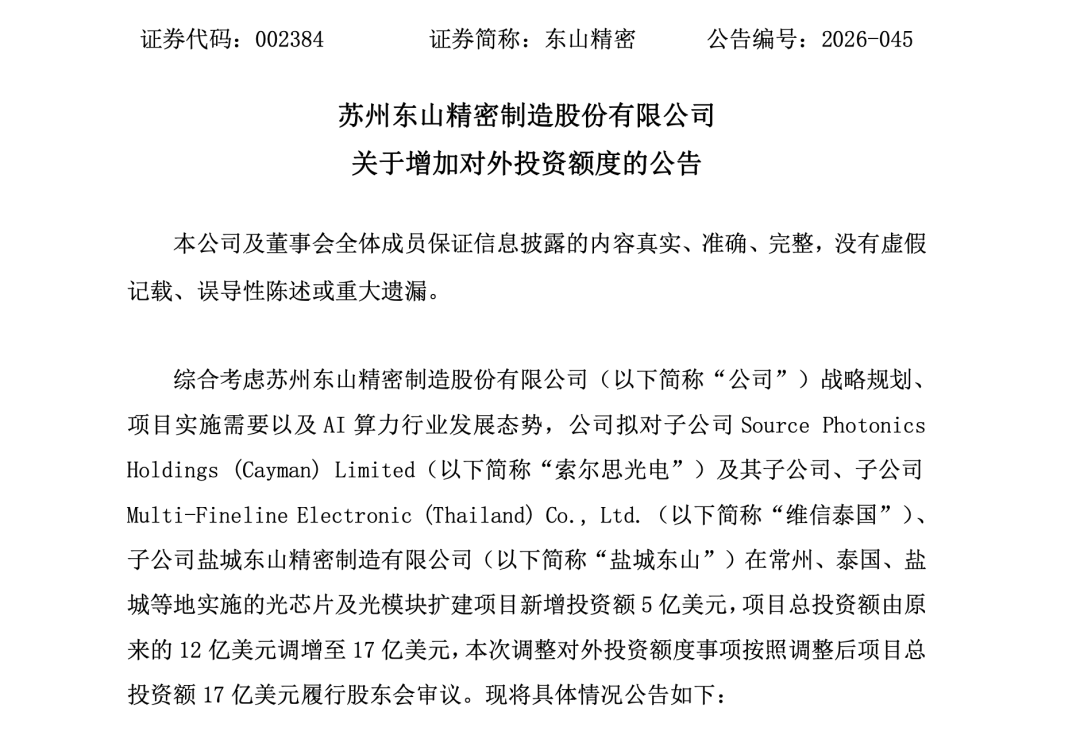
公告显示,东山精密董事会今年6月审议通过《关于对外投资的议案》,同意子公司索尔思光电及其子公司在常州等地实施光芯片及光模块扩建项目,彼时项目总投资额为12亿美元,资金来源为公司自筹资金,旨在提升索尔思光电整体产能规模,满足行业及下游客户需求。 综合考虑公司战略规划、项目实施需要以及AI算力行业发展态势,公司董事会8月20日审议通过《关于增加对外投资额度的议案》,同意对前述投资事项进行调整。

B | 调整后,光芯片及光模块扩建项目的实施主体仍为索尔思光电(及其子公司)、维信泰国、盐城东山,投资总额17亿美元,资金来源为公司自筹资金。

C | 东山精密指出,光芯片及光模块是AI算力产业的核心基础元器件,索尔思光电现有产能规模已无法满足行业及下游客户需求,通过本次产能扩建,能够有效填补产能缺口,满足下游客户中长期规模化采购需求,持续优化索尔思光电产品结构,进一步提升公司整体盈利水平和行业地位。

D | 在可行性方面,东山精密称索尔思光电深耕光芯片、光模块研发制造领域多年,拥有完善的光芯片设计、制造、封装以及光模块组装、性能测试等全链条核心技术与生产工艺,核心团队具备丰富的研发制造经验,可实现产品技术迭代、工艺优化、批量量产的全流程落地。 公开资料显示,东山精密2025年通过收购索尔思光电切入光通信领域,成为国内少数、全球为数不多实现高端EML光芯片规模化量产的企业。 东山精密主要从事电子电路、光模块(含光芯片)、精密组件、光电显示模组的全球设计、生产和销售,产品广泛应用于消费电子、汽车、数据中心、通信设备、工业控制设备等领域。 2026年上半年,东山精密实现营业收入277.98亿元,同比增长63.95%;归母净利润29.57亿元,同比增长290.09%。报告期内,除索尔思和GMD合并因素外,光模块业务新客户、新产品持续导入,营收大幅增长。 (文章来源:证券时报·e公司)。
Current article:http://ijkcrc.cengzaodengchawonin.cyou/t7z1s60/h49p.html
Published on:11:45:44